
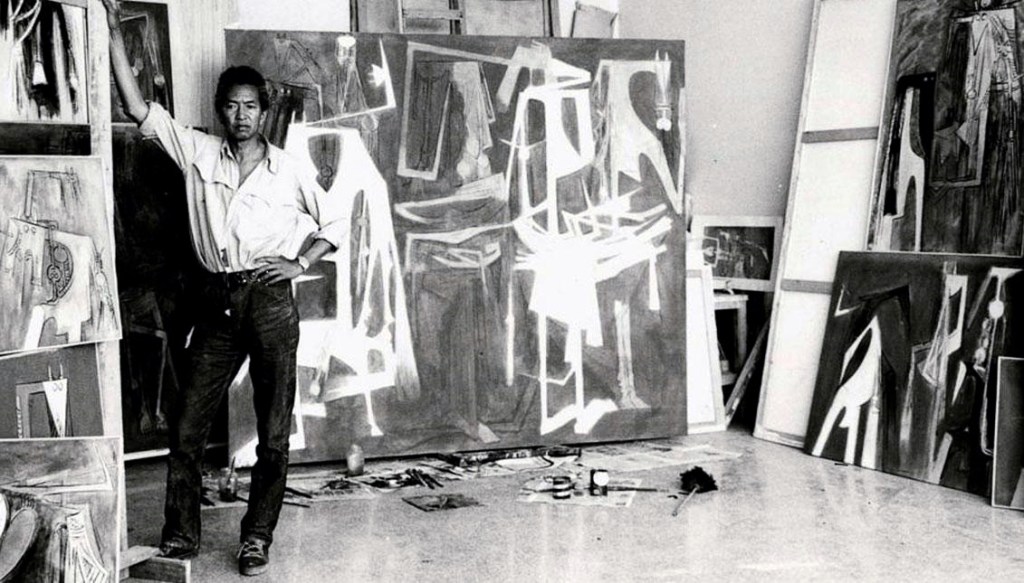
THE CUBAN ARTIST
WIFREDO LAM


“My painting is an act of decolonization not in a physical sense, but in a mental one.”
From MoMA
ABOUT THE ARTIST: A pivotal figure of Latin American modern art, Wifredo Lam was born in 1902 in Cuba, the son of a Chinese father and an Afro-Cuban mother of Spanish descent. After graduating from Havana’s Academia Nacional de Bellas Artes San Alejandro, he won a scholarship in 1923 to study at the Museo del Prado in Madrid, where he stayed until 1938, when he moved to Paris. There he was enthusiastically embraced by the city’s avant-garde, whose members at the time were fascinated with the unconscious, the fantastic, and the non-European cultures of Africa, Oceania, and the Americas. As a Caribbean of African descent, Lam held a particular appeal for these artists and poets (especially Pablo Picasso and André Breton), who perceived his race as playing a distinctive role in his work. In 1940, after the Nazis had occupied Paris, Lam escaped via cargo ship for an arduous journey back to Cuba. The voyage included a layover in the French Caribbean island of Martinique, where he met the poet Aimé Césaire, a founder of the Négritude movement, whose ideas would have an enduring influence on the artist.
Artwork Credit: Fair Use | Biographical information provided by MoMA.
 ART | library deco
Share Your Feedback with ART | library deco!